
Staying on the Bike
I started mountain biking when I was a teenager. I worked in our family sports store, and bikes were a huge part of what we sold. The mechanics I worked with and looked up to rode mountain bikes, so I did too. From then on, it's always been something I've loved.
From time to time, I'll read or hear something about the state of "flow" - getting into a space where time fades away and everything is focused on just doing this one thing. That's mountain biking for me.
When I'm on the bike, I'm untouchable. I can see roots on the ground flying by and intuitively know how to steer through them (called "finding my line"). I can anticipate a climb based on the way a track feels, and I can find a good line and ride, mostly brake-free, down a hill, using high-banked corners (called berms) to navigate my way down.
I'm fast, and while I'll take some risks, I'm always mindful not to push too hard. I've had my share of broken bones and concussions on the trail over the years, and I'm not inclined to put myself back in a sling.
Last weekend, I joined my four-person team for our annual 24-hour mountain bike race. The format is simple: the race starts at noon on Saturday and ends at noon on Sunday. The team who completes the most laps wins. If two teams tie, the win goes to whoever finished their last lap first. It's a test of both speed and endurance... and, to some degree, of irrationality.
There are hundreds of teams and thousands of riders who compete every year. In our category of 4-person teams, there were almost 40 to beat this year.
Over 24 hours, riders complete anywhere between 4 and 8 laps of the 16.5km track. Many riders cover over 100km of trail over the weekend. Myself included.
Three weeks before the race, I sprained my ankle playing hockey.
I wasn't able to train the way I needed to. I did some light rides, iced my ankle to keep the swelling down, and it hurt every time I went out.
I love riding my mountain bike. But when it comes to racing, I get competitive. I'm fast, and if I'm racing, I want to do well.
Getting hurt meant I wouldn't be in top shape on race day. That got me questioning whether I should race at all. Once that thought was in my head, more excuses showed up fast.
Whitney would have to cover for me with the kids all weekend.
Not sleeping at the race would leave me wrecked for days after.
We'd have to push our drive up to the cottage back a day, right at the start of our summer holiday.
Maybe it would just be easier not to race. The ankle was just the excuse that showed up on time.
As we get older, we collect an enormous number of good, reasonable, responsible-sounding excuses not to do the things that used to light us up. We're busier. Our bodies don't bounce back the way they used to. We've got people depending on us. We tell ourselves we've outgrown it, or that we've already proven what we needed to prove, or that it's someone else's turn now.
Every one of those reasons is legitimate. That's exactly what makes it so easy to leave the things we love behind.
But I don't think it's a coincidence that the things we loved when we were young are so often the things that make us feel young again, once we actually let ourselves do them. Not because the activity itself has some kind of magic. Because doing them requires something we stop practicing as we get older: showing up fully, without a guarantee, and finding out what we're still capable of.
My ankle gave me a perfectly good reason to skip this one... and I'm so glad I didn't.
I went out on my first lap and put down a top time for our team. I passed dozens of riders on the trail. I finished feeling strong, energized, and more than anything... alive.
As the race went on, the ankle held up. A couple of my laps were slower than I would have liked. But I was still putting down strong times for our team.
We finished 4th. Twenty minutes off the podium. Already hungry to fight for 2nd or 3rd next year. I can't wait to do it again.
So here's what I'd ask you. What's something you used to love, that you've let a good excuse talk you out of? And what would it cost you to show up for it anyway, not at your best, not fully ready, just showing up? The 40-, 50-, or 60-year-old version of you might not be able to do it like you did at 18... but at least you're still doing it.
I'll finish a ride both exhausted AND recharged. I think that's the whole point.
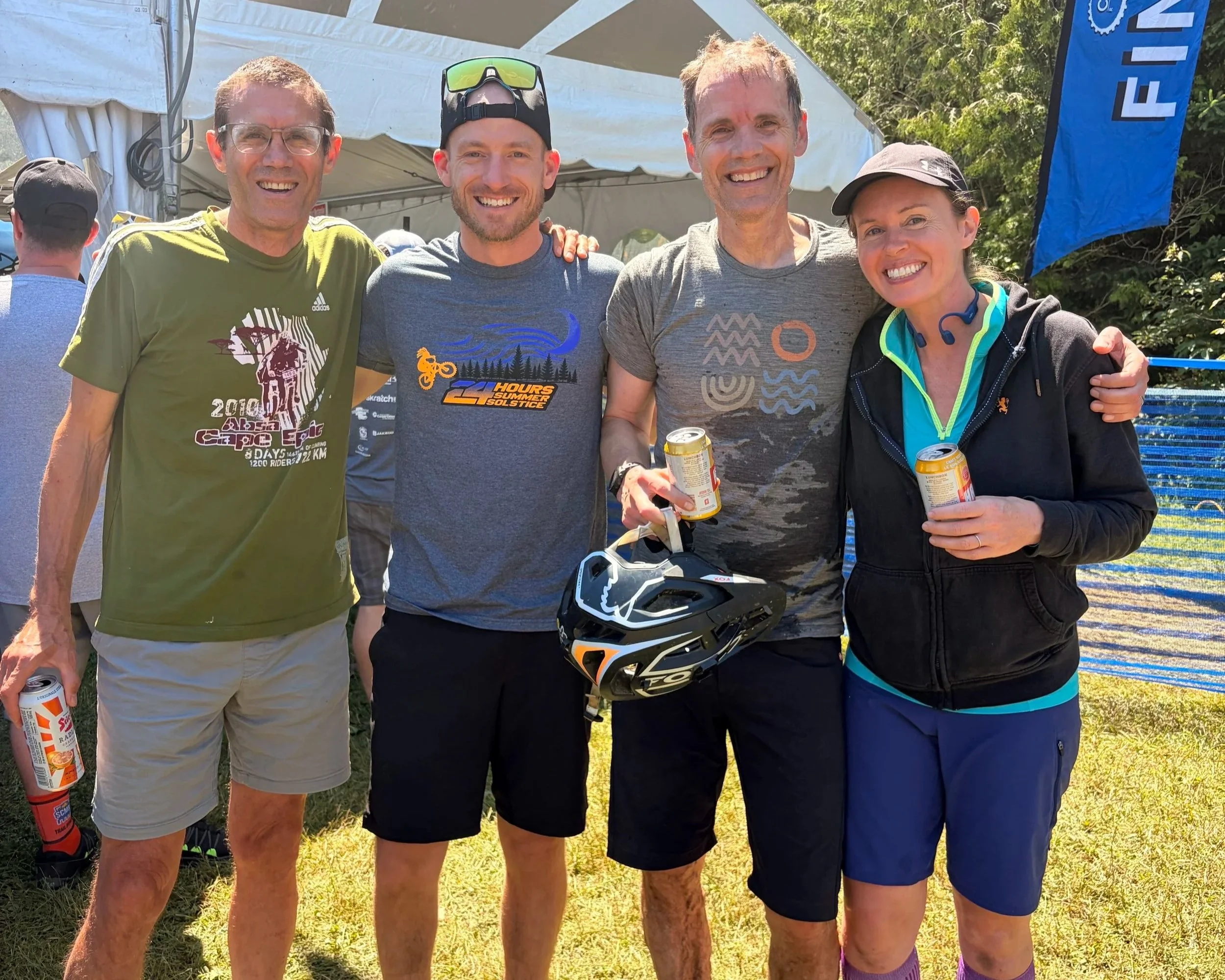
Exhausted, dirty, and all smiles after 24 hours of racing.
THE. BEST.